- Fluctuo EU Weekly Recap
- Posts
- 📱One App to Rule Them All: Eindhoven’s Unified Approach to Shared Mobility
📱One App to Rule Them All: Eindhoven’s Unified Approach to Shared Mobility
Plus, bikes take over trains in Germany, Ryde multiple launches in...

Alex Gauquelin
24 Mar
TOP STORIES 🔥
📱One App to Rule Them All: Eindhoven’s Unified Approach to Shared Mobility
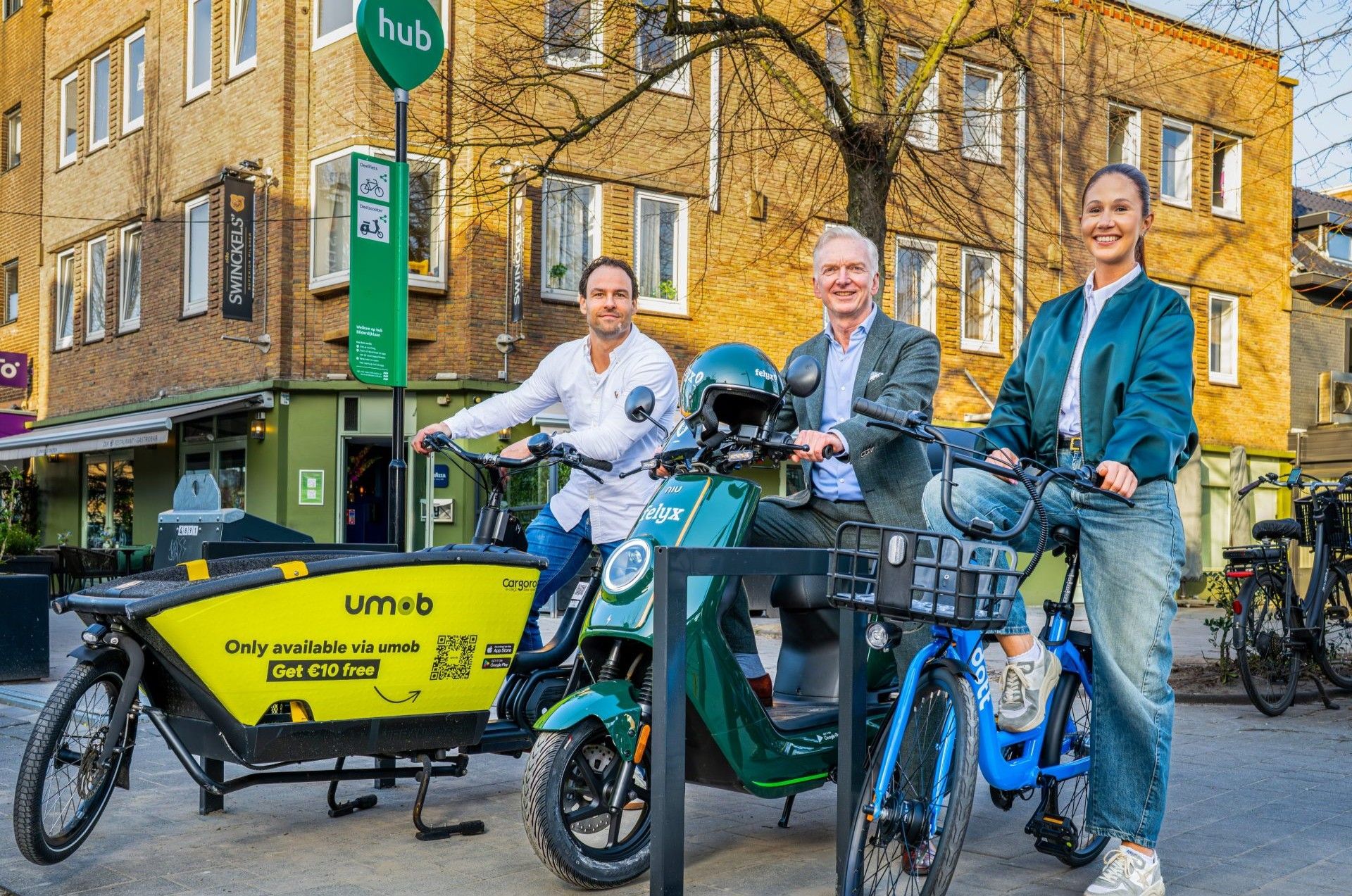
Eindhoven has just done something no other city has done before: appointing a MaaS provider — umob — full responsibility for every shared vehicle in the city. Bikes, e-bikes, e-mopeds, cargo bikes are now unified under one contract, one app, one point of contact through an 11-year concession.
It sounds simple. It isn't.
From permits to concession — a structural shift
Until now, Eindhoven has been managing shared mobility the way most European cities do: through individual permits, one per operator, with no coordination between services and no unified user experience. The city decided to move to a formal concession, run as a competitive tender with structured dialogue. The goal, says Daan Olislagers from the City of Eindhoven, was clear from the start: "affordability and availability — and the will to have a single service."
umob won the concession against competition that included all the major international players. According to its founder Raymon Pouwels, the model itself was a first: "Going through a tender for this kind of integrated service was new. One single party is responsible for everything — a single service alongside public transport." He's confident it won't remain unique for long: several similar tenders are reportedly underway across the Netherlands and beyond.
How it actually works
Under the concession, umob is contractually responsible for the performance of the entire network. Dott operates bikes and e-bikes, felyx the e-mopeds, Cargoroo the cargo bikes - a total of 2,500 véhicles in Eindhoven for a start. However, if fleet sizes or balancing targets are not met, the city holds umob accountable as the single point of contact. As Pouwels puts it: "If bikes are missing, umob is responsible for filling the gaps. There are minimum fleet requirements but no maximum — it will adapt to demand."
Operators retain day-to-day operational control. Revenue flows through a kickback model: a significant portion of the city's €800,000 annual subsidy is passed through to operators to enable lower fares. umob earns commission on transactions.
The city will ultimately monitor performance through dashboards built by umob — giving Eindhoven a consolidated view it never had before: trip data and patterns per modality, average prices, subscriptions and related usage patterns, service efficiency, demand by location, and more. "That data allows us to make data-driven decisions about shared mobility," says Olislagers.
The pricing architecture
Affordability is the heart of the model. The concession sets a price cap : a flat unlock fee covering the first 20–30 minutes, with no per-minute charge during that period; a way to avoid rushing, and therefore improve riders' and other road users’ safety. The €800k annual subsidy cuts fares by roughly 50% during the initial phase. Olislagers explains the logic: "A maximum cap is set, subsidy lowers the price, and the long contract convinces operators to work on pricing."
Pay-per-ride starts at €1.50 for a standard bike and €2.50 for an e-bike. Monthly subscriptions launch in November, from €19.95 - for 40 trips per month which covers all commuting bike rides - to €119.95 for full access across all vehicle types.
Why 11 years?
The long duration raised eyebrows. The city's answer is structural: "A concession means a long-term partnership — you need to bet on investments to build a reliable service," says Olislagers. The structure is 3+4+4 years. The city funds the 500 mobility hubs being rolled out across Eindhoven; the contract provides the framework to use that infrastructure effectively. The longer-term ambition is to scale from Eindhoven to the wider Brainport region - encompassing 21 surrounding municipalities - with umob as the single digital gateway.
The bigger question
The Eindhoven model challenges a deeply ingrained assumption in European micromobility: that cities should manage operators individually and leave the user experience to the market. Eindhoven has decided it won't, and structured its concession accordingly. Pouwels is direct about the replicability: "We are ready to deploy in any city." The pipeline is building.
🚉 When the Train Doesn't Arrive, nextbike Steps In

Deutsche Bahn is trying something new. From 10 April, a three-month closure of the S11 line between Köln-Mülheim and Bergisch Gladbach — affecting over 15,000 daily commuters — will be partly covered by a dedicated nextbike fleet, branded "S11-Bikes" and bookable via the nextbike app.
The journey normally takes 13 minutes by S-Bahn. Replacement buses need 37. The bikes cover the 10km route with stops at all five stations along the line. Pricing is €1 per 15 minutes, free for 30 minutes for regional rail subscribers.
It's a small pilot — 50 bikes at launch — but the signal is significant: bike-share is entering the rail disruption toolkit, not just the last-mile one.

LAUNCHES & EXPANSIONS 🚀
Bizkaiabizi
Expansion to Leoia (ES) 🚲(3 stations)
BAQME
Launch in Schiedam and Veenendaal (NL) 🚲 (50)
Donkey Republic
Launch in the Ruhr Region (DE) 🚲 (5,766)
Freebike
Season launch in Trnava (CZ) 🚲
Upcoming launch in …
You’re missing out on 11 launches & expansions. Subscribe to premium to read on.
PAUSES & EXITS ⛔️
You’re missing out on 2 pauses & exits. Subscribe to premium to read on.
TENDER WATCH 👀
You’re missing out on 4 crucial tenders. Subscribe to premium to unlock all.
CITY UPDATES 🌐

Brussels (BE) | The Observatoire du Vélo releases accidents and safety data.
Kefalonia (GR) | The bike-share service suffers from vandalism.
Subscribe to premium to reveal 12 more city updates.
INDUSTRY NEWS 🗞️
Assosharing lobbies against mandatory licence plates for scooters in Italy (IT).
Bolt study shows that shared e-bikes ease pressures on London Tube.
The European Commission backpedals on the single-cell repairability requirement for LEVs batteries.
An important fire hit Felyx’s warehouse in Amsterdam (NL).
Leo&Go published key figures from 2025 including a 8% EBIT.
Lime launched its latest LimeBike in the UK to attract women and older riders.
Lime offered free ride to voters during the municipal elections in France (FR).
Ridemovi offered free ride to voters during a referendum in Florence (IT).
Whoosh and others operators in Moscow (RU) implemented SMS rentals to adapt to mobile internet restrictions.
pony opens its first corner shop, and launches a cargobike subscription service in Angers (FR).

That’s all for this week.
Thanks for reading. If you have any feedback, just hit reply.
Reply